
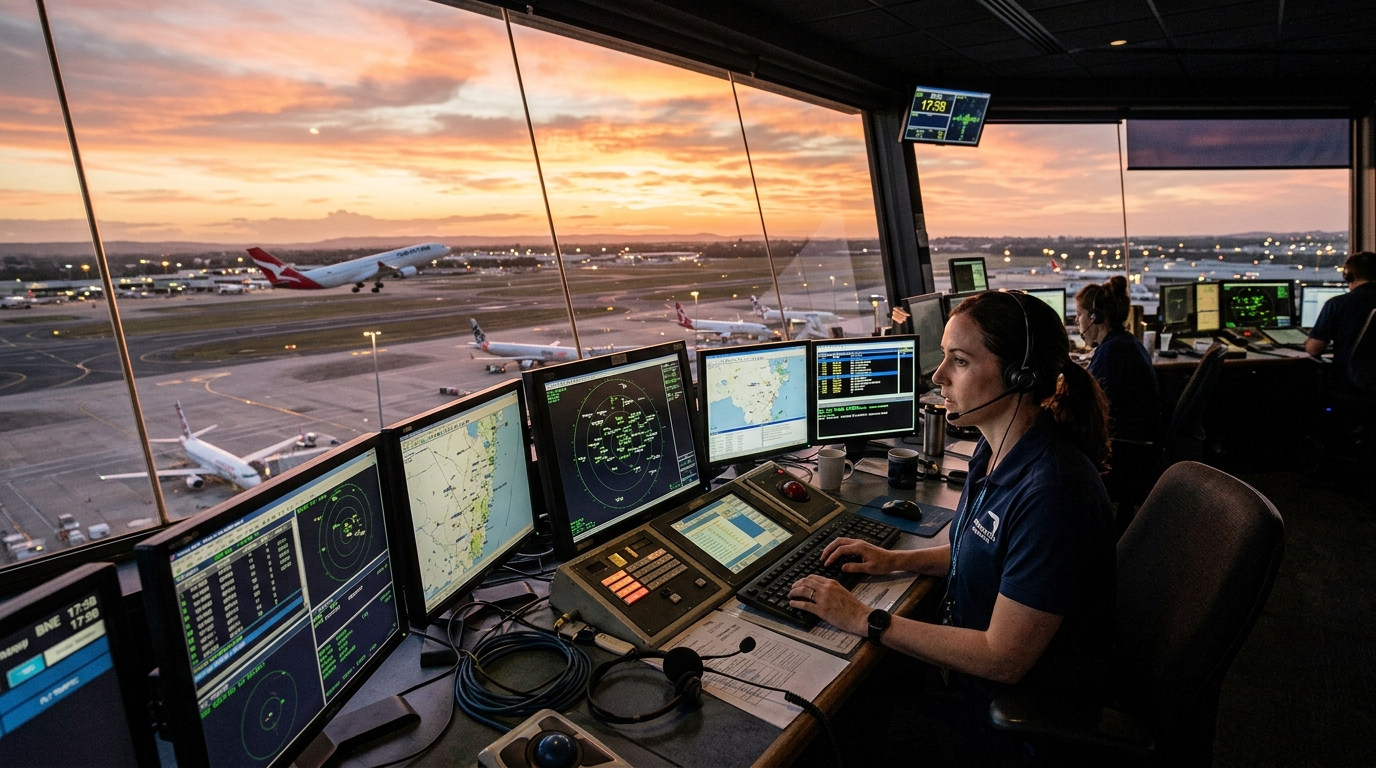
Responsible for managing over 11% of the world’s airspace—spanning 51 million square kilometers across continental Australia, the Indian Ocean, and the Southern Ocean to the edge of Antarctica—Airservices Australia operates one of the most technologically advanced and mission-critical air traffic management systems on the planet. Safely coordinating millions of commercial passenger journeys, international freight corridors, and defense flights, Air Traffic Controllers (ATCs) represent the ultimate apex of situational awareness, rapid spatial decision-making, and stress resilience.
Employer Profile: Airservices Australia
Unlike pilots who work for competing commercial airlines, all civilian Air Traffic Controllers in Australia are employed by a single federal government-owned statutory corporation: Airservices Australia. Funded by service charges levied on commercial airlines rather than taxpayer dollars, Airservices provides fully funded, paid ab-initio training programs for successful applicants, making it one of the rare premier careers requiring zero prior aviation experience to enter.
The Two Operational Specialisations: Tower vs. En Route Control
Controllers operate within two distinct, highly specialized environments:
1. Tower (Aerodrome) Control
Located in airport control towers (such as Sydney Kingsford Smith, Melbourne Tullamarine, Brisbane, Perth, and Bankstown), Tower Controllers visually monitor and separate aircraft on runways, taxiways, and within local airport airspace (typically within a 5 to 10 nautical mile radius):
- Tower Controller (TWR): Authorises take-offs and landings, manages wake turbulence separation between heavy widebodies, and coordinates missed approaches.
- Ground Controller (GND): Manages the orderly flow of aircraft taxiing between passenger terminals, hangars, and active runways, preventing runway incursions.
- Clearance Delivery (DEL): Issues route clearances and squawk transponder codes to departing flight crews.
2. En Route and Terminal Radar Control
Operating from two state-of-the-art consolidated Air Traffic Services Centres (ATSC) located in Melbourne and Brisbane, Radar Controllers monitor aircraft over thousands of miles using advanced satellite, radar, and ADS-B feeds:
- Approach / Departure Control (TMA): Manages inbound and outbound traffic within terminal maneuvering areas, sequencing arriving jets into dense single-file landing streams.
- En Route Sectors: Manages high-altitude cruise corridors (FL280 to FL450), executing speed adjustments, lateral radar vectors, and oceanic step-climbs across the continent.
The Rigorous Multi-Stage Selection Pipeline
With thousands of applicants competing for fewer than 100 trainee academy spots annually, Airservices conducts one of the most demanding cognitive screening processes in Australia:
- Online Cognitive & Spatial Testing: Psychometric evaluations assessing 3D spatial orientation, dynamic mental tracking, working memory, and rapid mathematical estimation under intense time pressure.
- Virtual Video Interviews: Behavioral scenarios evaluating personal accountability, communication conciseness, and team cohesion.
- Assessment Center Simulation: Full-day assessment at Airservices headquarters involving computer-based radar control simulations, group problem-solving exercises, and high-fidelity stress evaluation.
- Aviation Medical Examination: Securing a CASA Class 3 Medical Certificate, assessing cardiovascular health, normal color vision, audiometric hearing, and psychological stability.
- Security Clearance: Completing Baseline national security vetting through the Australian Government Security Vetting Agency (AGSVA).
Australian Air Traffic Controller Remuneration Benchmarks
Air Traffic Controllers in Australia are among the highest-earning salaried professionals in the public sector, governed by the transparent Airservices Australia Enterprise Agreement:
| Training / Career Stage | Operational Location | Base Remuneration (AUD) | Total Annual Package (Inc. 15.4% Super & Shift Penalties) |
|---|---|---|---|
| Trainee Controller (Academy Phase) | Airservices Learning Academy, Melbourne | $56,000 – $64,000 | Paid tuition + accommodation allowance |
| Field Trainee (OJT Phase) | Operational Tower or Radar Centre | $72,000 – $85,000 | $85,000 – $102,000 |
| First-Year Endorsed Controller (ATC Step 1) | Regional Tower (e.g. Albury, Launceston) | $118,000 – $132,000 | $140,000 – $162,000 |
| Experienced Radar Controller (ATC Step 3 – 5) | Melbourne / Brisbane Centre (En Route) | $145,000 – $175,000 | $175,000 – $215,000 |
| Senior Major Metro Tower Controller | Sydney / Melbourne / Brisbane Tower | $170,000 – $205,000 | $205,000 – $250,000 |
| Operations Shift Manager / Check Controller | National Operations Centre (Canberra/Melb) | $195,000 – $235,000 | $235,000 – $285,000+ |
Fatigue Management and The 90-Minute Rule
To eliminate cognitive fatigue and maintain supreme situational vigilance, Airservices enforces strict statutory rest intervals. Controllers are legally restricted from working more than 90 to 120 consecutive minutes on an active console without a mandatory 30-to-45-minute relief break in dedicated rest lounges. A standard working week averages 36 hours across rolling 24/7 rosters, accompanied by six to seven weeks of fully paid annual leave each year.
The OneSKY Revolution: Transforming Australian Airspace
Australia is currently deploying OneSKY, a multi-billion-dollar joint civil-military air traffic management system developed in partnership with Thales. Unifying civilian commercial airspace management with the Royal Australian Air Force (RAAF), OneSKY integrates advanced trajectory-based operational tools, automated conflict prediction algorithms, and voice-over-IP communications, ensuring Australia remains at the global vanguard of air traffic innovation.
Civil-Military Airspace Harmonisation & Joint Defence Coordination
A distinctive feature of Australian air traffic control is the close integration of civilian commercial traffic with Royal Australian Air Force (RAAF) military fast-jet and transport operations. Controllers stationed at joint-user aerodromes (such as Darwin, Townsville, and Newcastle/Williamtown) operate integrated radar consoles, coordinating synchronized arrivals between commercial passenger jets and supersonic military training maneuvers within active restricted military airspace danger areas.
Search and Rescue (SAR) & Distress Phase Management
Air Traffic Controllers form the frontline emergency response network for aircraft encountering inflight distress. When an aircraft declares an urgency (PAN-PAN) or distress (MAYDAY) state, or experiences communication failure, controllers immediately activate statutory emergency phases: Uncertainty Phase (INCERFA), Alert Phase (ALERFA), and Distress Phase (DETRESFA). Controllers collaborate instantaneously with the Australian Maritime Safety Authority (AMSA) Joint Rescue Coordination Centre (JRCC) in Canberra, orchestrating real-time aerial search vectors and emergency beacon triangulation.
Frequently Asked Questions
Do I need a university degree to apply to Airservices Australia?
No. A university degree is not required. Applicants must be at least 18 years of age, hold Australian citizenship or Australian permanent residency, have completed Australian Year 12 (or equivalent), and pass the intensive cognitive aptitude assessments.
How long is the training at the Airservices Learning Academy?
The institutional training at Melbourne Airport spans approximately 12 months of intensive computer simulator drills and theory, followed by 6 to 9 months of On-the-Job Training (OJT) under instructor supervision at an assigned operational tower or radar centre before solo rating endorsement.
What happens if a controller loses their Class 3 Medical?
Airservices provides comprehensive loss of medical license insurance schemes and structured transition pathways into non-operational roles, such as airspace design, flight simulation instruction, safety auditing, or national flow management.

