
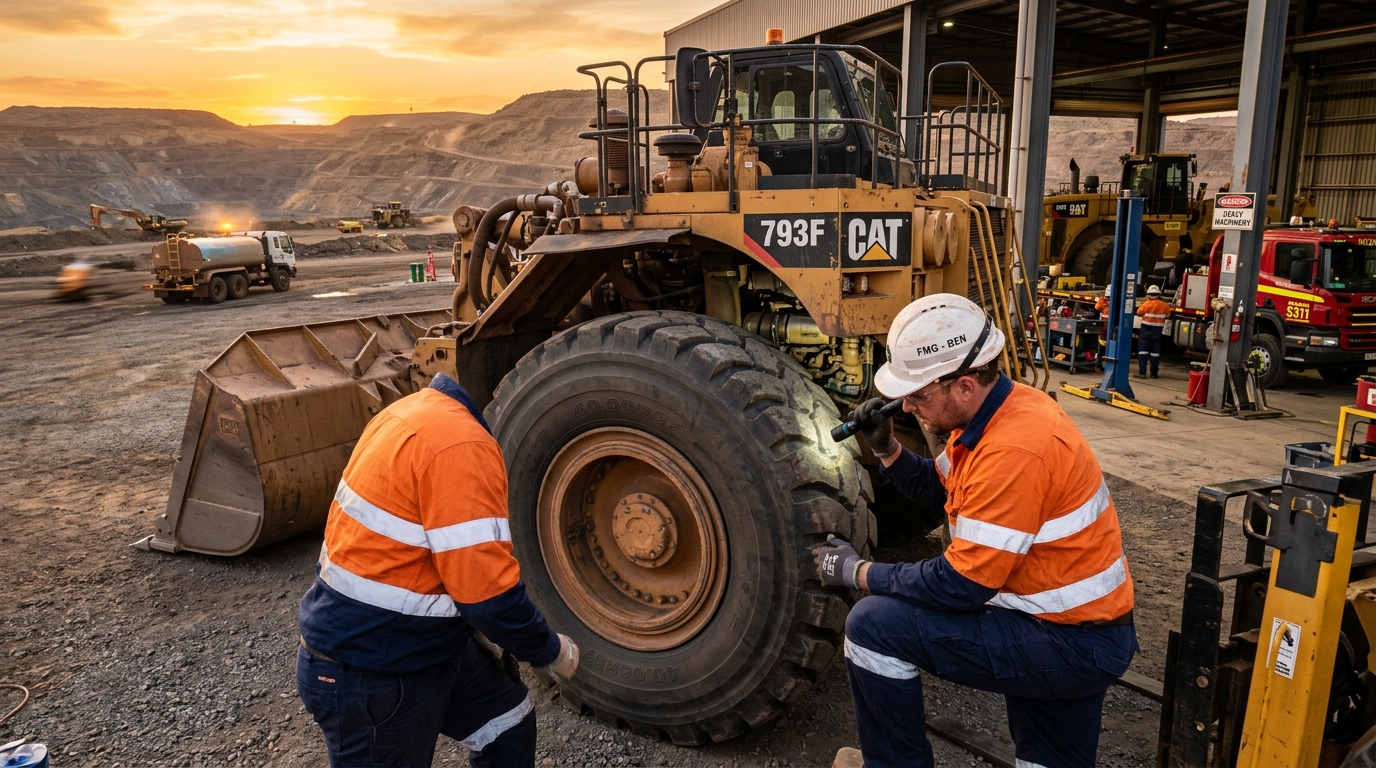
Australia’s resource and mining sector is a colossus of the global economy, exporting hundreds of millions of tonnes of iron ore, metallurgical coal, gold, lithium, and rare earths annually. The massive mechanical marvels that extract and haul this wealth—such as 400-tonne haul trucks, hydraulic excavators with buckets the size of garages, and high-production blast hole drill rigs—operate under punishing, non-stop 24/7 operating cycles. Keeping these multi-million-dollar assets running at peak reliability is the job of the Heavy Diesel Fitter (Mobile Plant Mechanic), one of Australia’s highest-compensated trade professionals.
The Machines of the Mine: What Heavy Diesel Fitters Service
Working as a heavy diesel technician on a premier mine site in Western Australia’s Pilbara region (servicing giants like BHP, Rio Tinto, or Fortescue) or Queensland’s Bowen Basin involves wrenching on the largest mobile earthmoving equipment on Earth:
- Ultra-Class Haul Trucks: Caterpillar 793F and 797F, Komatsu 930E, and Liebherr T 284 trucks powered by 16-cylinder, 4,000-horsepower twin-turbo diesel engines with electric wheel motor drives.
- Hydraulic Mining Shovels & Excavators: Hitachi EX5600 and Caterpillar 6060 shovels operating immense high-pressure hydraulic circuits (exceeding 350 bar) and complex swing drives.
- Heavy Production Dozers & Graders: Caterpillar D10/D11 track-type tractors and massive 24M motor graders maintaining heavy haul road corridors.
- Blast Hole Production Drills: Sandvik and Epiroc rotary blasthole rigs featuring automated mast hydraulics and high-pressure air compressors.
The FIFO Lifestyle & Typical Shift Rosters
Most mining heavy diesel fitters operate on a Fly-In Fly-Out (FIFO) basis, flying from capital city hubs (such as Perth, Brisbane, or Adelaide) directly to private mining airstrips. Accommodation, all meals, gym facilities, and laundry are provided free of charge in dedicated mining accommodation villages:
| FIFO Roster Pattern | Working Days vs. Home Days | Weeks Worked per Year | Lifestyle & Earnings Profile |
|---|---|---|---|
| 2:1 Roster (Two Weeks On / One Week Off) | 14 days on (12-hr shifts) / 7 days home | ~34 weeks worked / yr | Highest gross earnings; grueling long-term fatigue, intensive camp time |
| 8:6 Roster (Eight Days On / Six Days Off) | 8 days on (12-hr shifts) / 6 days home | ~29 weeks worked / yr | Popular balance between solid earnings and frequent rest periods at home |
| 2:2 Even-Time Roster (Two On / Two Off) | 14 days on / 14 days off | 26 weeks worked / yr | The gold standard work-life balance; 6 months off per calendar year |
| 4:3 / 9-Day Fortnight (Residential Mining Town) | Monday to Thursday or residential shifts | Standard full-time | Living locally in towns like Karratha, Newman, or Moranbah with subsidized housing |
Australian Heavy Diesel Fitter Remuneration Landscape
Due to the critical shortage of mobile plant technicians and the extreme financial cost of equipment downtime (an idle ultra-class excavator can cost a mining company $50,000+ per hour in lost production), diesel fitters command extraordinary remuneration:
| Career Level / Contract Structure | Hourly Rate (AUD) | Annual Base Salary | Total Annual Package (Inc. Super & Site Bonus) |
|---|---|---|---|
| Apprentice Mobile Plant Technician (4th Year) | $28 – $36 / hr | $65,000 – $80,000 | $75,000 – $92,000 |
| Workshop Fitter (Metropolitan Dealership / OEM) | $48 – $58 / hr | $100,000 – $120,000 | $115,000 – $138,000 (standard hours) |
| Permanent Mine Site Owner-Operator Fitter | $62 – $75 / hr | $145,000 – $175,000 | $170,000 – $210,000 (inc. 12% super + retention bonus) |
| FIFO Field Service Contractor (Labour Hire) | $75 – $95 / hr | $160,000 – $210,000 | $185,000 – $240,000+ (dependent on hours) |
| Dual-Trade Fitter / Auto-Electrician | $85 – $110 / hr | $185,000 – $240,000 | $215,000 – $280,000+ |
| Field Service Breakdown Contractor (Own Service Truck) | $140 – $190 / hr (dry/wet) | $280,000 – $420,000 gross | High contractor cash flow; self-funded insurance & depreciation |
The Dual-Trade Advantage: Fitter + Auto-Sparky
Modern mining equipment is increasingly controlled by sophisticated electronic sensors, CAN-bus communication networks, and electric drive motors. Tradespeople who hold dual qualifications—a Heavy Commercial Mechanical Certificate (AUR31220) combined with an Automotive Electrical Certificate (AUR30320)—are the undisputed kings of the workshop floor. Dual-trade technicians can diagnose a hydraulic spool valve failure and reprogram an electronic transmission controller on the same shift, commanding day rates upward of $1,200 to $1,500.
Safety Culture: Lock-Out Tag-Out (LOTO) and Isolation
Mine sites in Australia enforce some of the most uncompromising occupational health and safety standards in the world. Diesel fitters routinely interact with stored mechanical energy, 1,000-volt electric drive systems, and high-pressure fluid lines. Strict adherence to Positive Isolation (Lock-Out Tag-Out – LOTO), zero-energy state verification, and safe working permits is non-negotiable. Any deliberate breach of isolation protocol results in instant termination of site access.
The Technological Horizon: Autonomous Fleets & Battery-Electric Haulage
The heavy diesel trade is evolving rapidly. Mining majors have deployed hundreds of Autonomous Haulage System (AHS) trucks operating via GPS and LIDAR guidance with zero drivers in the cab. Furthermore, trials of 240-tonne battery-electric haul trucks and high-power pantograph trolley assist systems are actively underway. Tomorrow’s diesel fitter is as much a software diagnostician and high-voltage battery technician as they are a hydraulic wrench specialist.
Heavy Tooling Investments & Service Vehicle Setup
Operating as an independent heavy diesel contractor in the resources sector demands substantial upfront capital investment in specialized industrial tooling. A standard fit-out includes 1-inch and 3/4-inch drive pneumatic impact guns, hydraulic torque multipliers delivering up to 10,000 Nm, CAT Electronic Technician (ET) and Cummins INSITE diagnostic hardware, and precision dial gauges for measuring crankshaft end-float.
Contractors operating their own mobile breakdown business invest between $180,000 and $260,000 in custom mine-spec service vehicles (typically a reinforced 4×4 Toyota LandCruiser 79 Series or Isuzu NPS 4×4 truck) equipped with a hydraulic knuckle boom crane, diesel-driven screw air compressor, high-capacity oil evacuation tanks, and certified rollover protection (ROPS).
Frequently Asked Questions
What qualification is required to work as a heavy diesel fitter?
The standard benchmark trade qualification is the Certificate III in Mobile Plant Technology (AUR31220) or the Certificate III in Heavy Commercial Vehicle Mechanical Technology (AUR31120), completed through a four-year apprenticeship.
Can light vehicle (automotive) mechanics transition to heavy diesel mining?
Yes. Many mining contractors and equipment dealerships (such as WesTrac or Hastings Deering) offer accelerated 12-to-18-month ‘Trade Upgrade’ programs for qualified light vehicle mechanics to cross-skill into heavy mobile plant technology.
What medical and drug screening is required for FIFO mining?
Every FIFO worker must pass a comprehensive pre-employment mining medical examination, including audiometry hearing tests, spirometry lung function tests, musculoskeletal mobility assessments, and strict zero-tolerance 10-panel instant urine drug and breath alcohol screening.
