
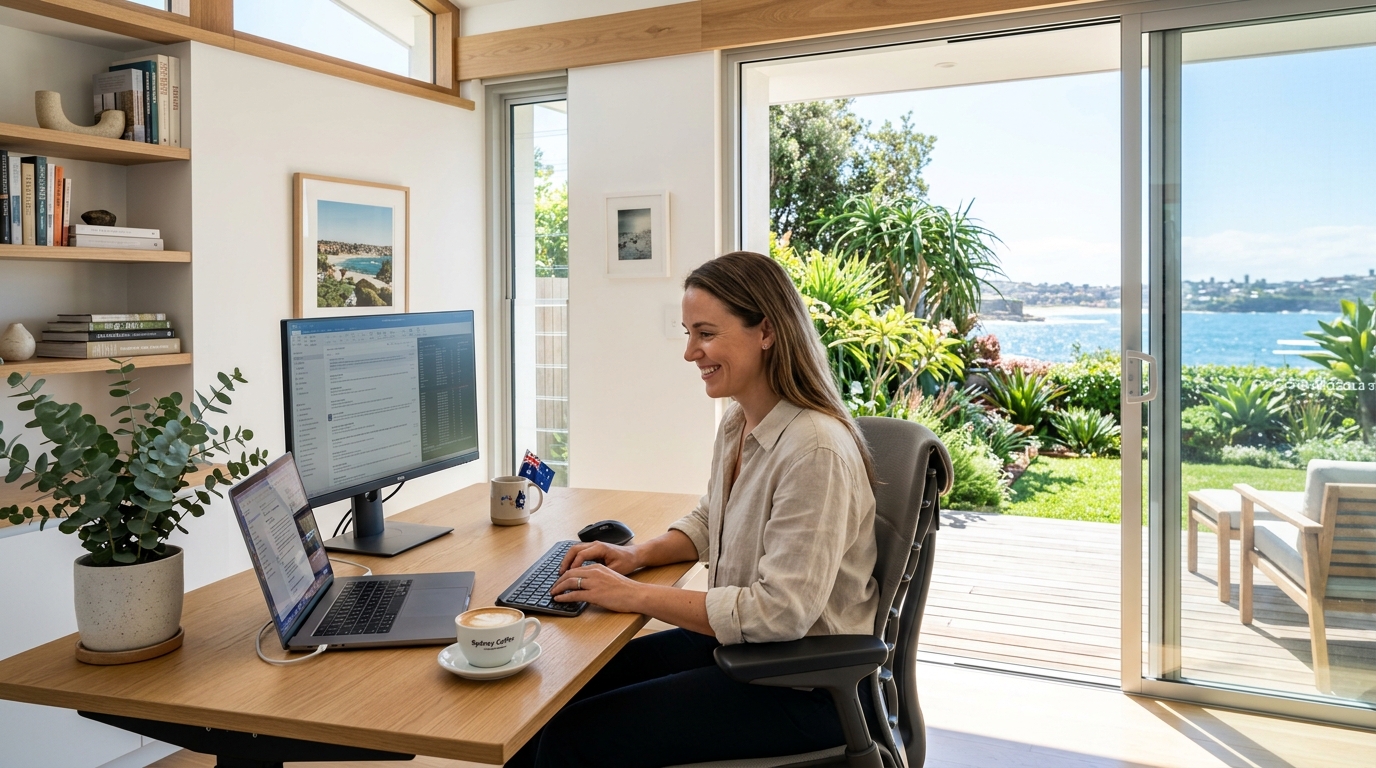
Working from home offers profound lifestyle and financial benefits, from eliminating soul-crushing commutes on the M4 or Monash Freeway to reducing daily expenditure on city lunches and transport fares. However, running a home office inevitably shifts overhead costs—such as electricity, high-speed broadband, mobile phone connectivity, and stationery—directly onto the employee. Fortunately, the Australian Taxation Office (ATO) provides structured deduction mechanisms allowing remote workers to claim substantial tax relief on their annual income tax returns.
Understanding ATO Eligibility Criteria
To claim any work-from-home (WFH) deduction in Australia, the taxpayer must satisfy three fundamental threshold criteria established under Section 8-1 of the Income Tax Assessment Act 1997 (ITAA 1997):
- You must have spent the money yourself and were not reimbursed by your employer.
- The expense must directly relate to earning your assessable employment income.
- You must possess contemporaneous records proving both the expenditure and the extent of work-related use.
You cannot claim deductions for personal, private, or domestic living costs—such as morning coffee, tea, pantry snacks, toilet paper, or general household heating for the entire family.
The Two Calculation Methods: Fixed Rate vs. Actual Cost
Taxpayers can choose between two calculation frameworks to optimize their tax deductions each financial year:
| Comparison Factor | Revised Fixed Rate Method (67¢ / hr) | Actual Cost Method |
|---|---|---|
| Rate / Basis | Flat $0.67 per qualifying work hour | Calculated actual percentage of utility bills and expenses |
| Expenses Covered in Rate | Home electricity, gas, internet data, phone usage, stationery, ink | None (each expense calculated and claimed individually) |
| Separate Additional Claims? | Yes: Decline in value (depreciation) of office furniture and tech assets > $300 | Yes: Depreciation of all assets, plus direct share of utility bills |
| Dedicated Home Office Required? | No. You can work from a kitchen bench, couch, or shared room | Yes. Must have a dedicated workspace/study to allocate running costs |
| Record-Keeping Burden | Continuous record of all hours worked (timesheets, logbooks) + one bill per category | Exhaustive records: receipts for all bills, appliance wattage logs, 4-week diary |
Diving into the Revised Fixed Rate Method (67 Cents per Hour)
The revised fixed rate method is by far the most popular and audit-resilient framework for everyday remote employees. At 67 cents per hour, a full-time professional working from home four days per week (30.4 hours weekly across 48 working weeks = ~1,460 hours) generates an immediate baseline deduction of approximately $978.20.
Crucially, claiming the 67 cents per hour rate does not preclude you from claiming the depreciation of capital equipment. If you purchased a high-end laptop, ergonomic desk chair, multi-monitor setup, or noise-cancelling headset, you can claim their decline in value on top of the 67 cents/hour rate.
Record-Keeping Rules for the Fixed Rate Method
The ATO enforces zero tolerance for rough estimates. To substantiate a fixed-rate claim, you must retain:
- A contemporaneous record of the actual hours worked from home across the entire financial year (such as an Excel log, electronic timesheets, or calendar invitations). Estimates or a simple four-week representative diary are no longer accepted for the fixed rate method.
- At least one monthly bill or invoice for each covered expense category (e.g., one electricity bill, one NBN internet bill, and one mobile phone bill) issued in your name.
The Actual Cost Method: When Is It Worth the Effort?
For individuals residing in large properties with high thermal conditioning costs, or specialized professionals running intensive computing rigs (such as machine learning training workstations or animation render farms), the Actual Cost Method can yield substantially higher deductions.
Under this method, you calculate the actual running cost of your appliances:
Cost = Power rating of appliance (kW) × Hours worked × Cost per kWh on energy bill
You must maintain a detailed four-week diary tracking your pattern of work, appliance usage, and personal versus business internet data consumption.
Depreciation of Work-Related Assets Under Division 40
For office equipment, furniture, and electronic hardware costing over $300, the expense cannot be claimed as an immediate deduction; it must be depreciated over its Effective Life using either the Prime Cost (straight line) or Diminishing Value method:
- Desks and Storage Units: Effective life of 20 years (10% diminishing value rate).
- Ergonomic Office Chairs: Effective life of 10 years (20% diminishing value rate).
- Laptops and Desktop Computers: Effective life of 2 to 4 years (50% diminishing value rate).
- Monitors, Keyboards, and Peripherals: Effective life of 3 to 4 years.
- Assets Costing $300 or Less: Eligible for an immediate, full 100% tax deduction in the year of purchase if used exclusively for work.
ATO Audit Targets & Five-Year Record Retention Protocols
In recent tax years, the ATO has announced intensified scrutiny over work-from-home deductions, warning taxpayers against “copy-pasting” claims from prior years or claiming round numbers without substantiation. Data-matching algorithms cross-reference energy billing spikes and employer STP (Single Touch Payroll) data indicating whether an employee was officially rostered on-site or working remotely.
Taxpayers must retain all receipts, electricity accounts, phone invoices, and contemporaneous timesheet logs for a minimum of five years from the date of lodging their tax return. Utilizing the ATO’s official myDeductions tool within the ATO app ensures receipts and work logs are digitally timestamped and uploaded directly into myTax at financial year-end.
Warning: The Capital Gains Tax (CGT) Trap of Occupancy Expenses
Employees cannot claim occupancy expenses (such as mortgage interest, council rates, house insurance, or landlord rent) unless their home qualifies as a genuine place of business with dedicated commercial signage and client visits. Claiming mortgage interest deductions immediately compromises your property’s Main Residence Exemption under CGT rules, triggering proportional Capital Gains Tax liabilities when you eventually sell your family home.
Frequently Asked Questions
Can I claim my home internet bill if it is in my spouse’s name?
Under ATO guidelines, if an expense is incurred jointly (e.g., a shared household internet bill in your spouse or partner’s name), you can still claim your proportional share of the work-related expense, provided you can demonstrate that you contributed to the household account payment.
Can I claim clothing or loungewear worn while working from home?
No. Conventional everyday clothing cannot be claimed, even if you only wear it during home working hours. Deductions are strictly limited to occupation-specific protective clothing or registered corporate uniforms.
What if my employer provided a one-off home office allowance?
If your employer paid you an allowance that is listed on your annual Income Statement (PAYG summary), that allowance must be declared as assessable income, and you can subsequently claim your allowable work expenses against it.
