
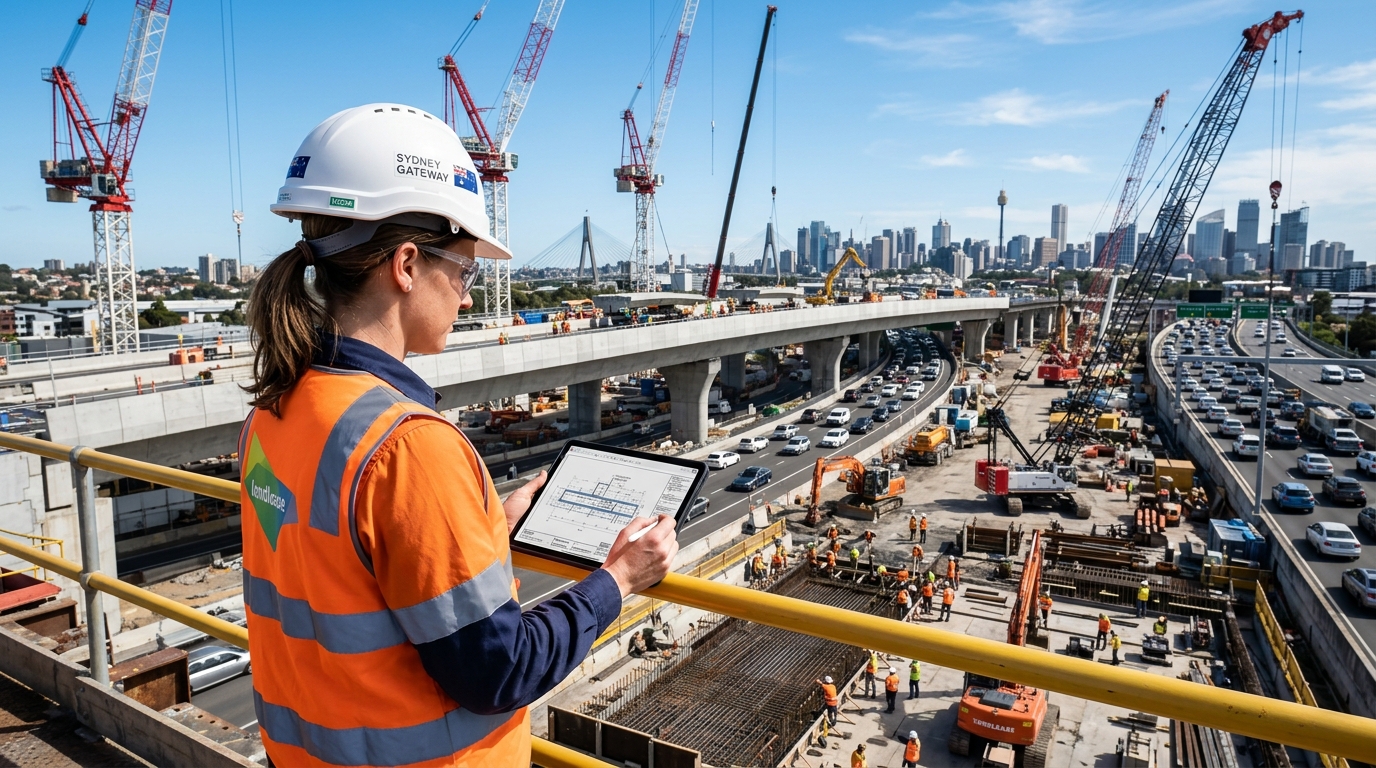
Australia is currently navigating an unprecedented generational infrastructure transformation. With multi-billion-dollar commitments spanning state and federal jurisdictions—ranging from high-capacity metropolitan passenger transit networks to vast regional renewable energy transmission zones—the demand for qualified, experienced civil and structural engineering talent has reached critical levels across every state and territory.
The Macro Driver: Australia’s Multi-Billion Pipeline
Major transport, water security, and civil works across Australia represent an active investment pipeline surpassing $250 billion. Premier initiatives such as the Sydney Metro West and Western Harbour Tunnel in New South Wales, the Suburban Rail Loop and North East Link in Victoria, the Cross River Rail and Coomera Connector in Queensland, as well as the METRONET expansions in Western Australia, are absorbing senior engineering capability at an unprecedented rate.
Simultaneously, the statutory declaration of Renewable Energy Zones (REZs) in regional New South Wales, Victoria, and Queensland has generated intense demand for civil project engineers capable of delivering heavy civil foundations, substations, access roads, and grid connection corridors in geographically remote topographies.
Top In-Demand Construction & Engineering Roles in Australia
Australian tier-1 contractors (such as CPB Contractors, John Holland, Fulton Hogan, and Laing O’Rourke) alongside major consultancies (WSP, AECOM, Aurecon, and GHD) consistently face supply shortfalls in five core technical disciplines:
| Role Title | Experience Tier | Key Focus Areas | Typical Australian Salary (AUD + Super) |
|---|---|---|---|
| Site Engineer (Civil / Structures) | 2–4 Years | Quality assurance, ITP sign-offs, daily subcontractor coordination | $105,000 – $135,000 |
| Project Engineer | 4–8 Years | Program scheduling, procurement, cost forecasting, design compliance | $140,000 – $175,000 |
| Senior Project Engineer | 8–12 Years | Major package delivery, contract claims, risk mitigation, client liaison | $180,000 – $215,000 |
| Construction Superintendent | 10+ Years | Site logistics, plant utilization, direct labour supervision, incident-free safety | $190,000 – $240,000 |
| Commercial / Contracts Manager | 7+ Years | Head contract administration (AS 4000 / AS 2124), variation negotiations | $165,000 – $220,000 |
Accreditation, Licensure & Compliance in the Australian Construction Sector
To secure mid-to-senior technical posts within Australia, candidates must demonstrate clear alignment with both statutory safety mandates and professional engineering charters:
1. General Construction Induction (White Card)
Every professional entering an operational construction site in Australia must hold a valid General Construction Induction Card (nationally accredited unit CPCCWHS1001 / CPCWHS1001). Recognized mutually across all Australian states through SafeWork authorities, this credential verifies foundational understanding of occupational risk control, personal protective equipment (PPE), and reporting protocols.
2. Professional Engineers Registration (NER & State Registers)
In jurisdictions like Queensland (RPEQ under the Board of Professional Engineers of Queensland) and Victoria (Professional Engineers Registration Act), engineers offering professional engineering services must be formally registered. New South Wales has implemented mandatory registration for engineers working on Class 2, 3, and 9c buildings under the Design and Building Practitioners Act. Achieving Chartered Professional Engineer (CPEng) status through Engineers Australia or registration on the National Engineering Register (NER) provides an undeniable competitive edge.
Industry Insider Tip: The Power of Verified ITP Experience
Tier-1 recruiters in Melbourne, Brisbane, and Sydney prioritize candidates who can explicitly discuss their direct responsibility for Inspection and Test Plans (ITPs), Lot closures, and non-conformance reporting (NCRs). When detailing past projects on your CV, always specify the contract delivery model (D&C, Alliance, or PPP) and the exact financial value of the civil work packages you supervised.
State-by-State Market Analysis
New South Wales (NSW)
Sydney remains the largest single infrastructure market in the Southern Hemisphere. Demand focuses heavily on underground tunneling, rail systems engineering, and station box civil construction. With Sydney Airport’s Badgerys Creek precinct rapidly developing into a full aerotropolis, Western Sydney is seeing massive logistics park construction alongside road arterial duplications.
Victoria (VIC)
Despite budget recalibrations across certain state-funded initiatives, major projects like the West Gate Tunnel and level crossing removals continue to absorb deep civil capability. Project engineers with specialized expertise in contaminated soil management, structural steel erection, and railway occupation shutdowns command substantial salary premiums.
Queensland (QLD)
With the countdown to the Brisbane 2032 Olympic and Paralympic Games underway, South East Queensland is experiencing a monumental construction upsurge. Substantial investments in the Bruce Highway upgrade, Gold Coast Light Rail Stage 3, and Olympic precinct sports infrastructure have created intense competition between state agencies and private delivery partners for senior construction personnel.
Western Australia (WA)
Supported by sustained mineral commodity strength, Western Australia combines massive civil resource construction in the Pilbara with urban Metronet rail developments in Perth. FIFO rosters combined with lucrative district site allowances make Western Australian civil engineering contracts among the most financially rewarding nationally.
Navigating the Modern Award & Enterprise Bargaining Agreements (EBAs)
Salaried engineers in Australia generally operate under the Professional Employees Award or individual common law contracts. However, on major infrastructure project sites, on-site personnel work in close alignment with site-wide Enterprise Bargaining Agreements (EBAs) negotiated with relevant trade unions (such as the CFMEU or AWU). Understanding RDO (Rostered Day Off) calendars, site allowances, travel subsidies, and weekend loading structures is vital when evaluating total remuneration offerings.
In Australia, statutory employer superannuation contributions currently stand at 11.5% and will incrementally climb to 12.0% under Commonwealth law. When evaluating offers, engineers should always clarify whether a remuneration figure is quoted as “exclusive of super” or as a total “cost-to-company package” to avoid unexpected shortfalls in base pay.
Key Takeaways for Jobseekers
- Highlight Project Scope: Quantify concrete pour volumes, earthworks tonnage, or linear meters of rail/pipeline delivered.
- Pursue Chartered Status Early: Professional registration via Engineers Australia opens accelerated pathways to senior package management.
- Prioritize Safety Governance: Familiarity with SafeWork guidelines, Chain of Responsibility (CoR) legislation, and zero-harm culture is essential during behavioural interviews.
Frequently Asked Questions
Can overseas engineers work on Australian infrastructure projects?
Yes. International engineers frequently enter Australia via the Temporary Skill Shortage (subclass 482) visa or Employer Nomination Scheme (subclass 186). A formal skills assessment through Engineers Australia (CDR pathway or Washington Accord) is mandatory for permanent residency pathways.
What is the typical working week for an Australian site engineer?
Metropolitan civil engineering roles typically involve a 50-to-55-hour working week, often including alternating Saturday morning shifts. Infrastructure occupations or major road shutdowns frequently require night shifts, which are rewarded with attractive penalty loading or flexible time-in-lieu arrangements.

